As part of our Workplace Evolution Series we want to provide several thought leadership articles about the current and future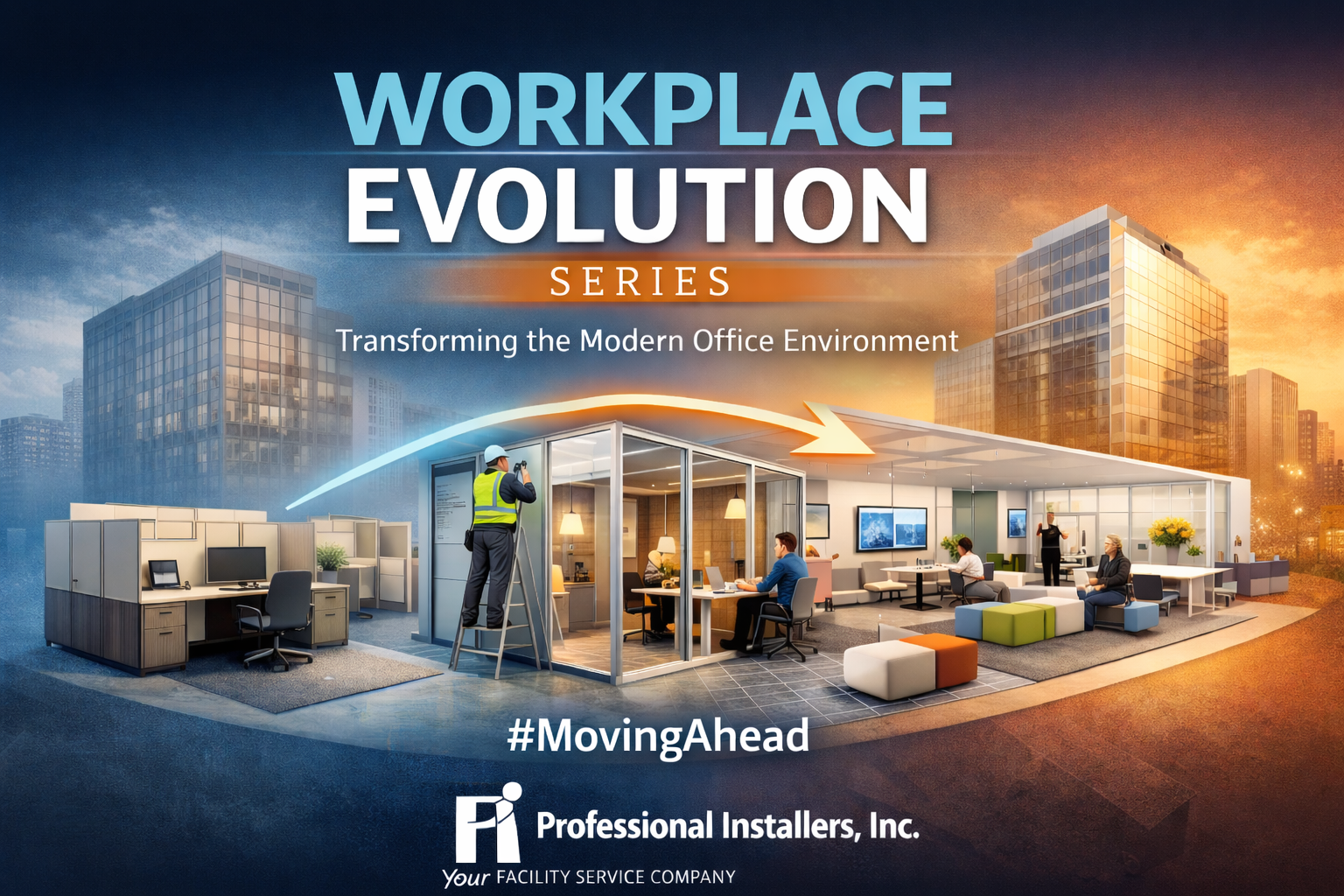 states of the office environment.
For the past decade, the workplace conversation has revolved around a single question:
Is the office still relevant?
Today, that debate is largely settled.
The office isn’t disappearing.
But it is being fundamentally re-engineered.
Across corporate real estate portfolios, organizations are redesigning workplaces to support hybrid collaboration, strengthen culture, attract talent, and adapt faster as business needs evolve.
What’s emerging isn’t a smaller version of the traditional office. Instead, it’s a new generation of workplaces designed for flexibility, experience, and continuous change.
Yet as workplace strategies become more ambitious, many organizations are encountering a challenge that rarely gets discussed.
The growing divide between workplace vision and workplace reality.
The Workplace Is Now a Strategic Business Asset
For decades, office environments were designed primarily around space efficiency and standardization.
- Rows of workstations.
- Predictable layouts.
- Minimal change over time.
Today, corporate real estate leaders are thinking about workplace design very differently. The office is no longer just a place to house employees—it’s a strategic tool that influences collaboration, culture, productivity, and talent attraction.
Organizations are asking new questions:
- How does our workplace support hybrid teams?
- How does the office reinforce company culture?
- How can our space evolve as our business evolves?
- As a result, workplaces are being designed less like static environments and more like dynamic systems that must adapt over time.
The End of Static Offices
Traditional office environments were built to last 10–15 years with minimal change.
But today’s organizations move too quickly for that model.
- Teams reorganize frequently.
- Technology changes constantly.
- Business priorities shift.
To keep up, companies are designing workplaces with adaptability built into the physical environment.
That’s why we’re seeing a growing emphasis on:
The goal is simple: Create workplaces that evolve as quickly as the organizations inside them.
But achieving that goal introduces new complexity.
The Workplace Execution Gap
As workplace design becomes more sophisticated, many organizations are discovering an unexpected obstacle, the gap between design vision and real-world delivery. We call this the Workplace Execution Gap.
It’s the difference between what workplace designers envision, what organizations expect, and what ultimately gets delivered in the physical environment.
This gap can show up in many ways:
- Collaboration spaces that don’t function as intended
- Workstations that limit flexibility instead of enabling it
- Technology that doesn’t integrate smoothly into furniture systems
- Environments that become difficult to adapt after installation
These problems rarely originate in design.
More often, they emerge during execution, when logistics, trades, technology, and timelines collide.
And as workplace environments become more complex, the execution phase becomes increasingly critical to project success.
Introducing the Workplace Execution Index
To better understand how workplace projects succeed, or struggle, we’ve started thinking about them through a framework called the Workplace Execution Index.
The Workplace Execution Index measures how prepared a workplace project is for successful delivery across four key dimensions:
- Design Alignment - Is the workplace designed with real-world installation and future reconfiguration in mind?
- System Integration - Do furniture systems, technology, power, and architectural elements work together seamlessly?
- Logistics & Coordination - Are project timelines, trade coordination, and installation sequencing aligned?
- Lifecycle Adaptability - Can the space evolve as the organization changes without major disruption or cost?
Projects that score high on the Workplace Execution Index typically experience smoother installations, fewer field conflicts, and workplaces that function as intended from day one.
Projects that score low often struggle with delays, rework, and operational challenges long after the space is occupied.
Where Workplace Transformation Becomes Real
Workplace transformation doesn’t happen in renderings or strategy sessions. It happens at the moment where design, logistics, and physical execution intersect. Today’s workplace installations often require coordination between architects, furniture dealers, technology integrators, electricians, facilities teams, and project managers. What once looked like a straightforward furniture installation has evolved into a complex orchestration of systems, trades, and timelines.
And that’s where workplace transformation becomes real.
Closing the Gap
As organizations continue to rethink the office, one truth is becoming increasingly clear:
- Great design alone isn’t enough.
- The success of a workplace project ultimately depends on how effectively that vision is executed in the real world.
- The organizations that succeed in this new era will be those that recognize execution as a critical part of workplace strategy, not simply the final step in the process.
Because when the execution is done right, the workplace becomes what it was always intended to be: A space where people collaborate, innovate, and move the organization forward.
Next in the Workplace Evolution Series
The Rise of the Modular Workplace
Why flexibility is becoming the most valuable feature in modern office environments.