The Rise of the Modular Workplace - Why Flexibility Is Becoming the Most Valuable Feature in Modern Office Environments
If Episode 1 answered the question “What is the office becoming?” Episode 2 answers a more practical one: How are organizations actually building for that future?
The answer is increasingly clear: Modularity.
Across corporate real estate portfolios, a fundamental shift is underway from designing fixed office environments to building modular workplaces that can evolve in real time.
And for many organizations, flexibility is no longer a “nice to have.” It’s becoming the most valuable feature of the modern office.
The End of “One-Time” Workplace Design
Historically, workplace projects followed a predictable pattern: Design → Build → Occupy → Maintain
Once installed, the space remained largely unchanged for years.
That model is quickly becoming obsolete. Today’s organizations face constant change:
- Hybrid work patterns shifting week to week
- Teams expanding, contracting, and reorganizing
- New technologies being introduced rapidly
- Business priorities evolving faster than real estate cycles
As a result, companies are no longer designing offices to be “finished.” They’re designing them to be continuously adaptable.
What Is a Modular Workplace?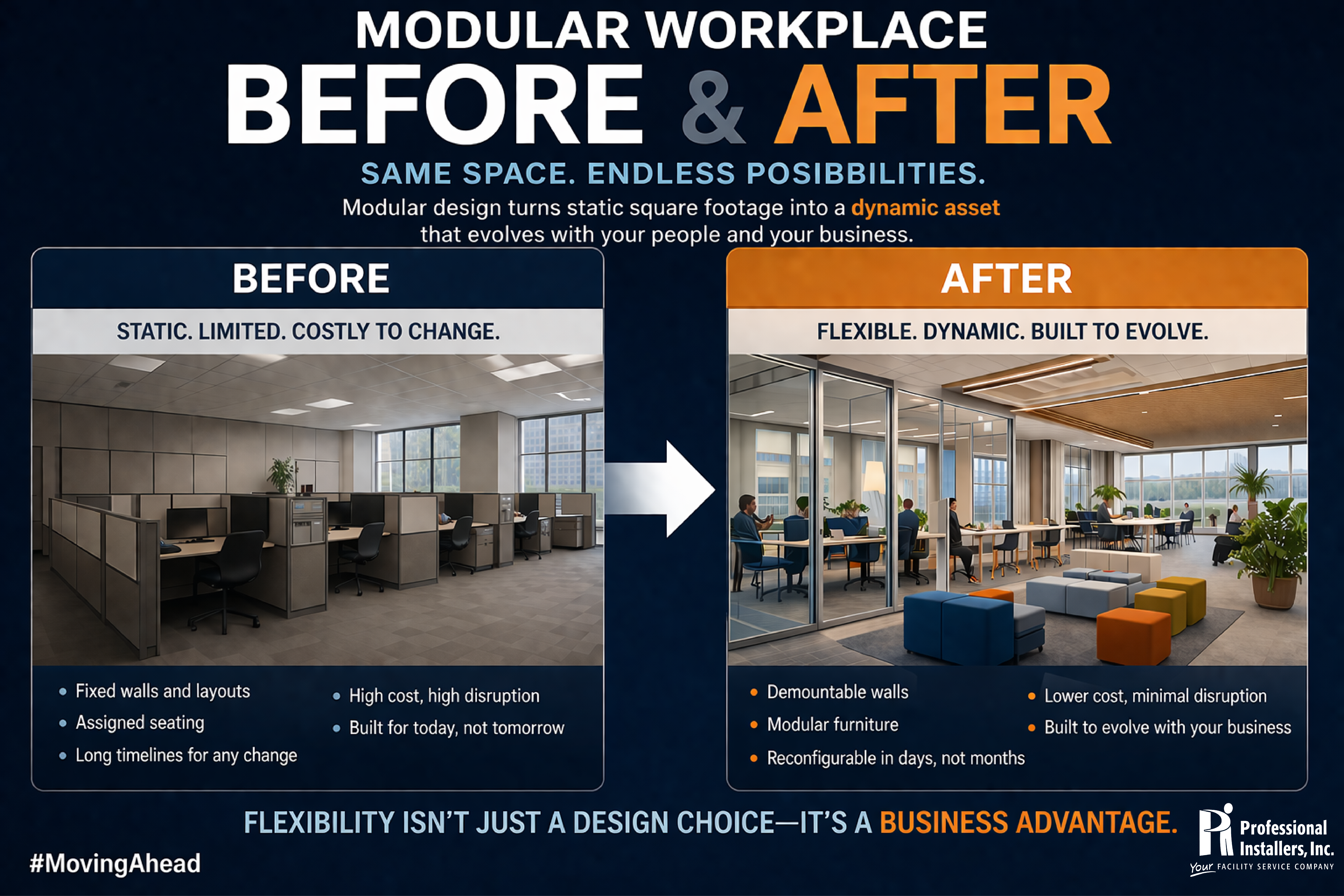
A modular workplace isn’t defined by a single product or system. It’s a design philosophy centered around flexibility, reconfiguration, and long-term adaptability.
It shows up in several ways:
The goal isn’t just flexibility. It’s controlled flexibility, which is the ability to evolve without disruption, downtime, or excessive cost.
Why Flexibility Has Become a Business Priority
For corporate real estate leaders, flexibility is no longer just a design preference. It’s a financial and operational strategy.
Traditional office changes often required construction timelines, significant capital investment, business disruption and long lead times.
Modular workplaces change that equation. They allow organizations to adapt spaces faster, reduce renovation costs, minimize downtime, extend the lifecycle of workplace assets and respond quickly to business changes
In many cases, flexibility is now directly tied to cost control, speed, and organizational agility.
The Workplace Evolution Curve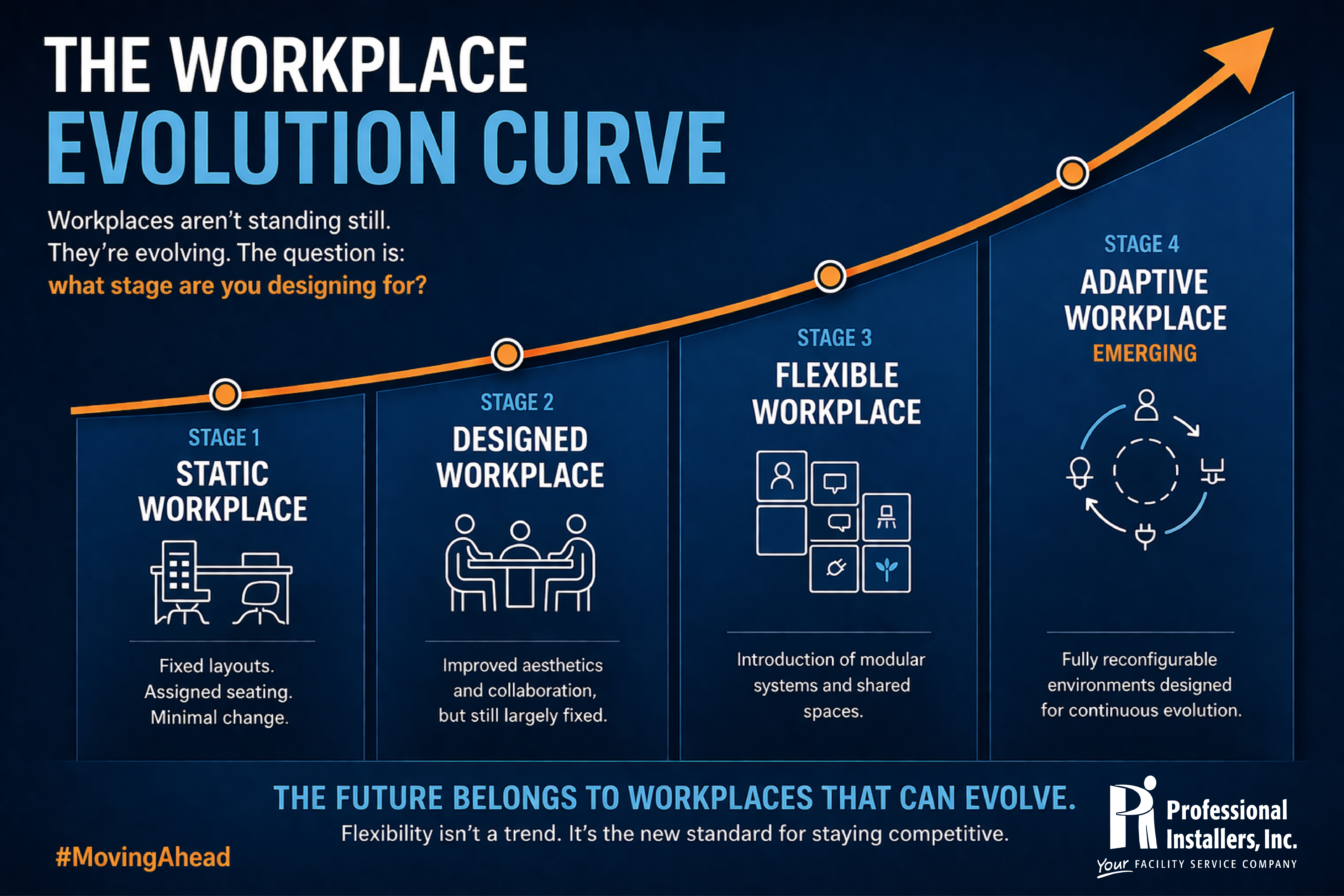
To better understand this shift, it’s helpful to look at how workplace environments have evolved over time.
Stage 1: Static Workplace - Fixed layouts, assigned seating, minimal change
Stage 2: Designed Workplace - Improved aesthetics and collaboration, but still largely fixed
Stage 3: Flexible Workplace - Introduction of modular systems and shared spaces
Stage 4: Adaptive Workplace (Emerging) - Fully reconfigurable environments designed for continuous evolution
Most organizations today are operating somewhere between Stage 2 and Stage 3. But the market is rapidly moving toward Stage 4 where adaptability is not just possible, but expected. And getting there requires more than design. It requires execution.
Modularity Increases Complexity
While modular workplaces offer clear advantages, they also introduce new challenges.
Flexibility doesn’t happen by accident. It must be engineered into the environment from the beginning.
That means:
- Systems must align precisely
- Components must integrate seamlessly
- Installations must anticipate future reconfiguration
- Teams must coordinate across multiple disciplines
Without that level of coordination, modular environments can quickly become:
- Difficult to reconfigure
- Inconsistent across spaces
- Costly to adjust over time
In other words, modularity can either unlock flexibility or create friction.
The Execution Factor
As discussed in our previous article, this is where the Workplace Execution Gap becomes even more critical.
Modular workplaces amplify both the upside and the risk of execution.
When done right:
- Spaces adapt easily
- Reconfigurations are efficient
- Technology integrates cleanly
- Long-term costs are reduced
When done poorly:
- Flexibility is limited
- Rework becomes common
- Systems don’t align
- Operational headaches increase
The difference is rarely the design. It’s the execution.
From Installer to Workplace Transformation Partner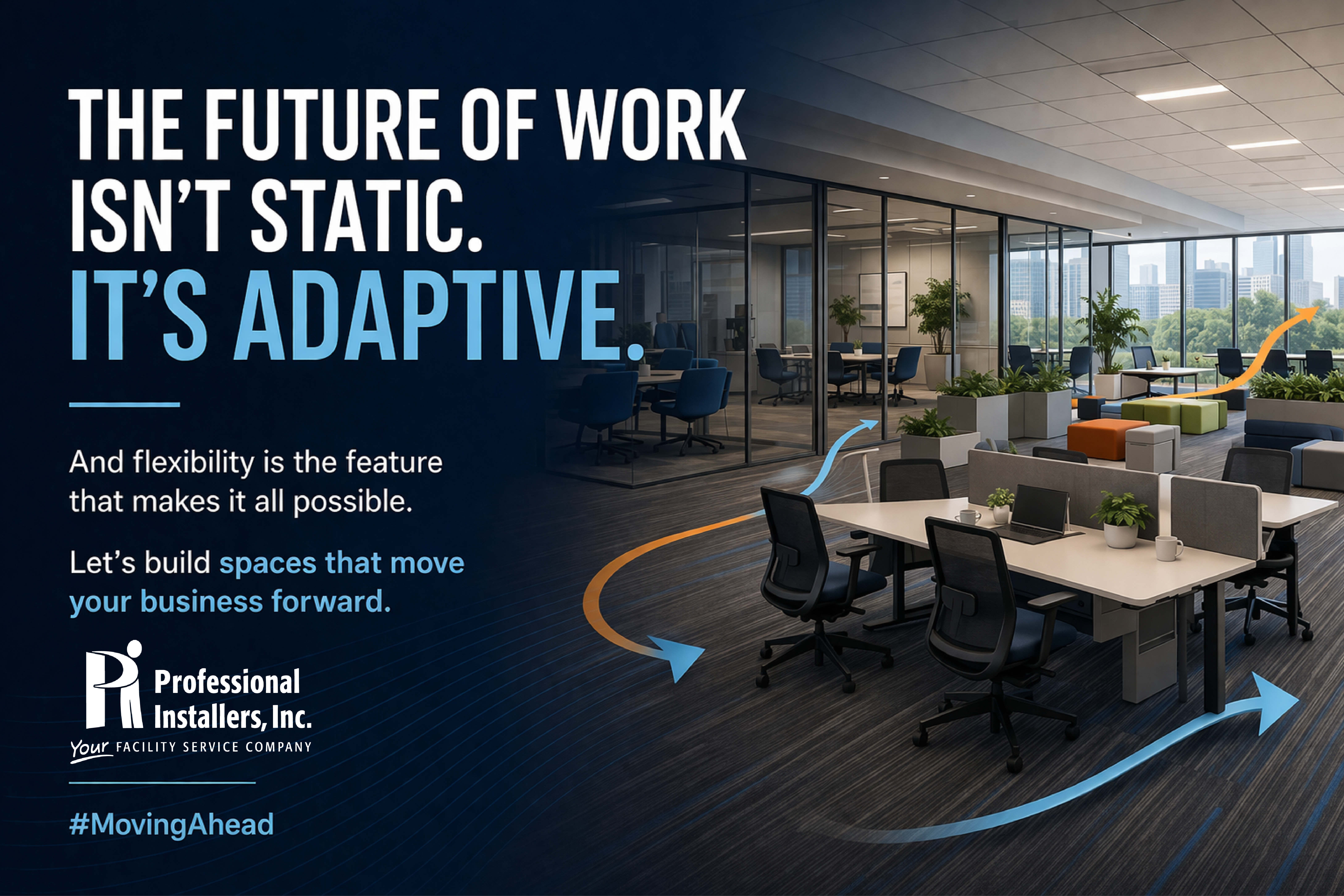
As modular workplaces become more prevalent, the role of installation is evolving alongside them. Installation teams are no longer simply delivering a finished product. They are helping organizations build environments that are designed to be adaptive.
That requires a different mindset:
- Understanding how spaces will evolve; not just how they are installed today
- Coordinating across furniture, technology, and architectural systems
- Ensuring long-term usability and reconfiguration
- Supporting the full lifecycle of the workplace
This is where the shift happens from installation provider to workplace transformation partner.
Because in a modular environment, the job isn’t just to install the space. It’s to ensure the space can continue to perform as the organization changes.
Key Takeaway
The rise of the modular workplace reflects a larger shift in how organizations think about space.
The office is no longer a fixed environment. It’s a living system that must evolve alongside the business. And in this new model, flexibility becomes the most valuable feature. But flexibility isn’t created through design alone.
It’s delivered through precision execution and long-term thinking.
Next in the Workplace Evolution Series
Why Speed of Workplace Deployment Matters More Than Ever
How compressed timelines and rapid change are redefining workplace delivery.