The Workplace Doesn't Stop Changing After Move-In.
In Episode 7, The Workplace Lifecycle: Why Occupancy Is Just the Beginning, we explored why modern workplaces must continuously adapt to changing business requirements. That evolution creates an operational challenge for facilities directors and corporate real estate leaders.
How do you keep a workplace functioning efficiently while responding to changes in staffing, space utilization and organizational priorities? Traditionally, many of these needs were addressed as separate projects, often involving different vendors. But a more coordinated approach can help organizations manage change while protecting existing investments.
The objective isn't simply maintaining an office. It's keeping the workplace aligned with the business.
Office relocations and internal moves involve far more than transporting desks and chairs. They require coordination among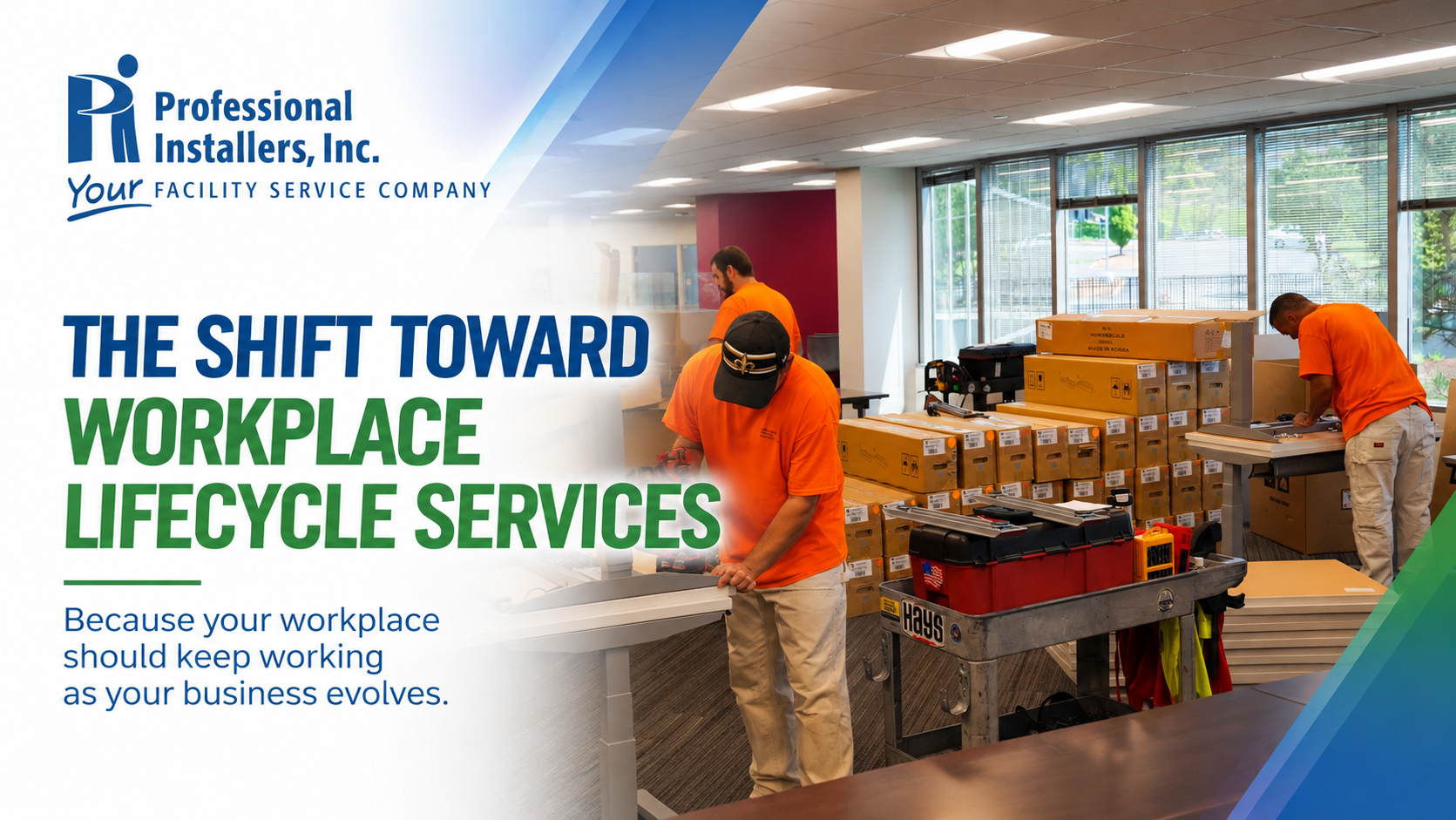 employees, facilities teams, technology providers, building management and installation crews.
Furniture must be inventoried. Workstations may need disassembly and reassembly. Technology connections must be coordinated. Schedules must account for building access and business operations. And increasingly, organizations expect these transitions to occur with minimal disruption.
That's why successful workplace moves depend on planning, communication and precise execution. The real measure of success isn't how quickly furniture moves from one location to another.
It's how effectively the organization continues operating throughout the transition.
As discussed in Episode 2, The Rise of the Modular Workplace, flexibility is becoming one of the most valuable characteristics of modern office environments. But flexibility only delivers value when organizations can act on it.
Consider a company that needs to accommodate additional employees without expanding its footprint. Existing workstations may be reconfigured. Underutilized areas may become collaboration spaces. Furniture systems may be adapted to support new team structures.
These changes can help organizations respond to evolving needs without automatically investing in entirely new environments. However, reconfiguration requires expertise. Furniture compatibility, component availability, electrical connections, layout requirements and installation sequencing all influence the outcome.
The ability to adapt an existing workplace can be just as valuable as the ability to create a new one.
Asset Reuse: Protecting What You've Already Purchased
Office furniture represents a significant investment, but organizations don't always have a complete understanding of the assets they own. Furniture may be distributed across multiple facilities, placed in storage or replaced simply because its availability isn't known.
A workplace lifecycle strategy encourages organizations to ask different questions before purchasing new products.
- Can existing furniture be reused?
- Can workstations be reconfigured?
- Are compatible components available?
- Could surplus furniture serve another location?
When organizations have better visibility into their workplace assets, they can make more informed purchasing and planning decisions. Asset reuse may reduce unnecessary expenditures, extend product life and support sustainability objectives.
It also represents a shift in thinking.
Furniture shouldn't be viewed solely as a project expense. It should be managed as a long-term business asset.
Furniture storage is often treated as a temporary solution when organizations have more assets than available space. But properly managed storage can support long-term workplace flexibility.
When a company consolidates offices, furniture may remain useful even if it isn't immediately needed. When the organization expands or reconfigures another location, those stored assets may become valuable again.
Receiving, warehousing, inventory management and coordinated delivery help make this possible.
The key is visibility.
Knowing what furniture is available, where it's located and whether it's suitable for reuse can help organizations respond more efficiently to changing requirements. Storage becomes more valuable when it's connected to an overall workplace asset management strategy.
From Installation Contractor to Workplace Transformation Partner
This shift also changes the relationship between organizations and their workplace service providers.
Traditionally, an installation partner might become involved near the end of a project and leave once the work is complete. Today, ongoing workplace change creates the necessity for longer-term relationships. A Workplace Transformation Partner can support the initial installation and continue assisting with relocations, reconfigurations, furniture maintenance, asset management and storage.
The advantage is continuity. A partner familiar with the facility, furniture systems and organizational expectations can help coordinate future changes without starting from scratch each time.
For facilities leaders, that means having a resource focused not only on completing individual projects but also on supporting workplace performance over time.
The Future of Workplace Services
As organizations seek greater flexibility from their workplaces, the value of ongoing support becomes increasingly apparent.
The question is no longer simply: "Who can install our office furniture?"
It's becoming: "Who can help us adapt, manage and protect our workplace investment as our business evolves?"
And that's how we keep our customers #MovingAhead.
Frequently Asked Questions
What are workplace lifecycle services?
Ongoing services that support workplace operations after initial installation, including office moves, furniture reconfigurations, maintenance, asset management and storage.
How can furniture reconfiguration reduce costs?
Reconfiguration may allow organizations to reuse existing furniture systems instead of purchasing replacements, depending on product compatibility and project requirements.
Why is furniture asset management important?
It helps organizations track existing furniture, identify reuse opportunities and make more informed decisions about purchasing, storage and relocation.