For decades, workplace projects had a clearly defined finish line: move-in day. 
The space was designed. Furniture was installed. Employees moved in. The punch list was completed. Project finished.
Except today's workplace doesn't work that way.
Organizations grow, contract and reorganize. Hybrid work changes how space is used. Technology evolves. Teams move. Collaboration needs change. Furniture gets reconfigured. The workplace that opens on Day One may not be the workplace an organization needs on Day 365.
That's why forward-thinking organizations are beginning to look beyond the workplace project and focus instead on the workplace lifecycle. The goal isn't simply to create a great workplace. It's to keep that workplace performing as the business changes.
The Workplace Isn't a Finished Product
A workplace may look complete on opening day, but operationally, its lifecycle is just beginning.
A department adds employees. Another shifts to hybrid schedules. A collaboration area needs to become private offices. Technology changes conference room requirements. An acquisition brings two organizations together.
These changes don't necessarily require a completely new workplace. They require an existing workplace to adapt.
This is the next evolution of the flexibility discussed in Episode 2: The Rise of the Modular Workplace. Flexibility isn't simply designing a space that can change. It's having the ability to execute change when the business requires it.
From Project Thinking to Lifecycle Thinking
Most workplace projects follow a familiar path:
Plan → Design → Build → Install → Occupy
But the modern workplace requires another cycle after occupancy:
Adapt → Reconfigure → Maintain → Optimize → Repeat
That changes the question corporate real estate and facilities leaders should be asking.
Instead of asking "Did we deliver the project successfully?" Consider asking "How effectively can this workplace continue to support our organization as our needs change?" That's the difference between managing an office as a static physical environment and managing it as a strategic business asset.
The Workplace Lifecycle
A more complete model for the modern workplace looks like this:
- PLAN - Define business requirements, employee needs and workplace objectives.
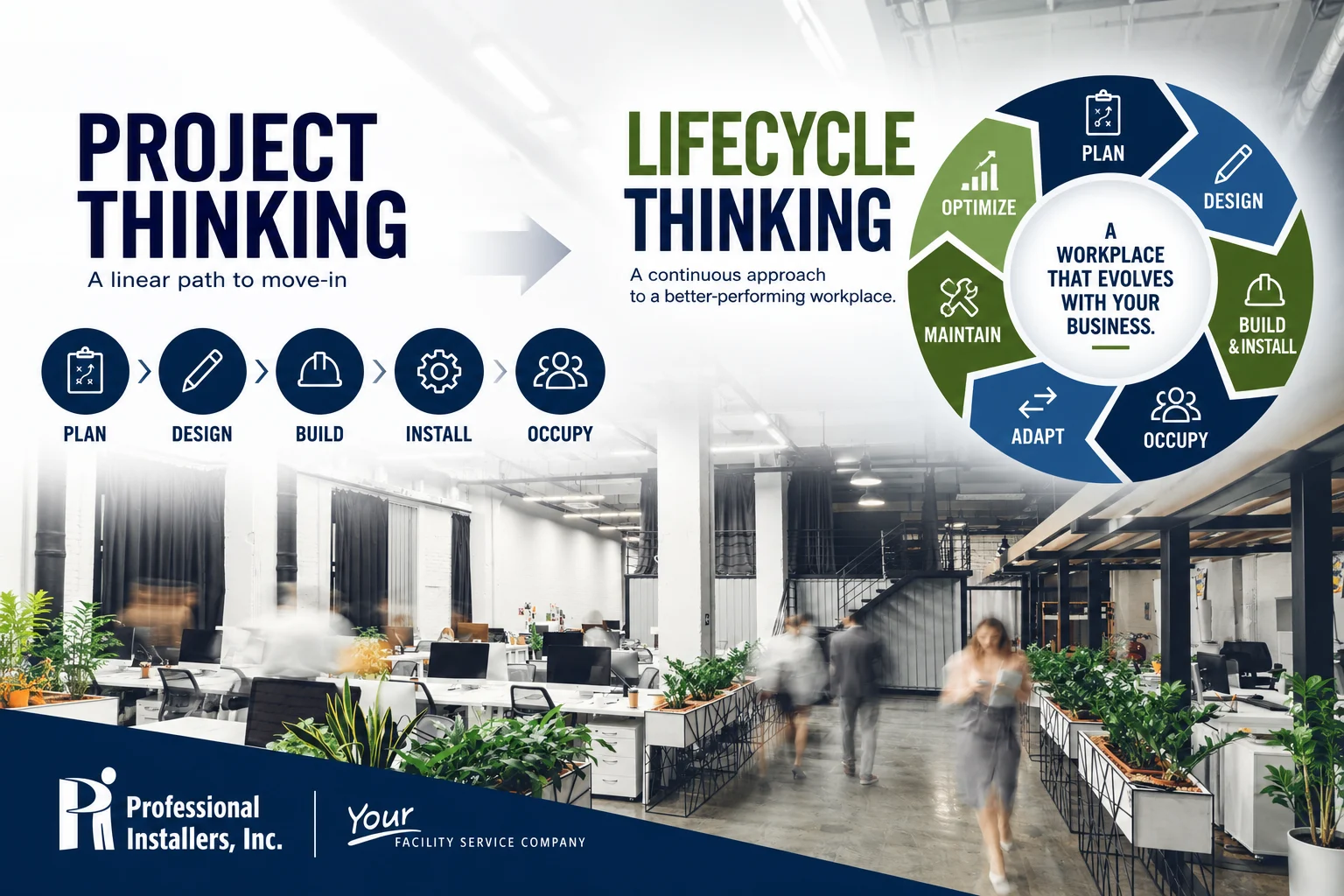
- DESIGN - Translate those requirements into an environment that supports how people work.
- BUILD & INSTALL - Coordinate furniture, technology, architectural elements and trades to bring the environment to life.
- OCCUPY - Transition employees into the workplace with minimal disruption.
- ADAPT - Respond to organizational change through moves, adds, reconfigurations and modifications.
- MAINTAIN -Protect furniture, architectural systems and workplace assets throughout their useful life.
- OPTIMIZE - Continue improving the environment as the organization and its people evolve.
Then the cycle begins again.
The workplace isn't a destination. It's an operating environment.
Protecting the Investment After Move-In
Organizations make significant investments in workplace furniture, architectural systems and infrastructure. The value of those investments shouldn't be limited to their original configuration.
A quality workstation may be reconfigured as a department grows. Furniture can move between locations. Modular architectural walls can adapt as space requirements change. Existing assets can be stored, maintained and redeployed rather than automatically replaced.
The ability to reuse and adapt workplace assets can help organizations extend their useful life while potentially reducing unnecessary construction, replacement costs and disruption.
That's why workplace lifecycle management increasingly includes more than installation. It can encompass furniture reconfiguration, moves and relocations, maintenance, architectural wall modifications, receiving and storage, inventory management and ongoing facility support.
These aren't necessarily separate projects. They're part of managing the workplace over time.
Workplace Transformation Is Becoming Continuous
This evolution also changes the role of the installation partner. Traditionally, installers entered near the end of a workplace project. Furniture arrived, crews installed it, the punch list was completed, and everyone moved on.
But when workplace change becomes continuous, the relationship can become continuous as well. Just as we explored in Episode 6: The Dealer–Installer Partnership That Makes Projects Work, the strongest workplace relationships operate less like traditional vendor arrangements and more like integrated delivery partnerships.
A workplace transformation partner understands not only how to install an environment, but how to help that environment evolve. The advantage is continuity. A long-term partner becomes familiar with the facility, furniture systems, standards, expectations and operational requirements. That knowledge can become increasingly valuable every time something changes. Instead of starting over with each reconfiguration, relocation or facility need, organizations have a resource that already understands the environment.
The New Measure: Workplace Adaptability
Throughout this series, we've explored speed, flexibility, coordination, design intent and execution.
The workplace lifecycle brings those ideas together because the performance of a modern workplace shouldn't be measured only by how successfully it opens. It should also be measured by how effectively it adapts.
- Can the environment respond when the organization grows?
- Can teams relocate without unnecessary disruption?
- Can furniture be reconfigured rather than replaced?
- Can architectural systems evolve without major demolition?
- Can changes happen while employees continue working?
Those questions increasingly determine the long-term value of workplace investments.
From Installer to Workplace Transformation Partner
There's an important distinction between the two. An installer helps complete a project. A workplace transformation partner helps the workplace continue performing throughout its lifecycle. That requires understanding the relationship between furniture, facilities, people, technology business operations, and recognizing that every workplace change has operational consequences.
For facilities directors and corporate real estate leaders, the opportunity is to think beyond the next project and build relationships with partners capable of supporting the environment over time. Occupancy isn't the finish line. It's the moment the workplace begins doing the job it was designed to do.
From that point forward, the organization will continue to change. People will move. Teams will evolve. Technology will advance. Space requirements will shift.
The question isn't whether the workplace will need to change.
It's how effectively it can change with the business.