There was a time when office installation was relatively straightforward.
Deliver the furniture. Assemble the workstations. Complete the layout.
But today’s workplace environments are far more sophisticated. Modern offices now integrate technology, flexibility, acoustics, architectural systems, and employee experience into nearly every square foot of the environment. And, as workplace design has evolved, so has the complexity behind delivering it successfully.
What many people still view as “office installation” has become something much bigger:
A multi-disciplinary execution process requiring coordination across multiple teams, systems, and trades.
The Modern Workplace Is Built Around Integration
Today’s workplace is no longer just furniture inside a room. It’s an interconnected environment designed to support:
- Hybrid collaboration
- Technology-enabled work
- Employee wellness
- Acoustic performance
- Flexible reconfiguration
- Brand and cultural experience
This shift is directly tied to trends explored in our earlier article: The Rise of the Modular Workplace
Modern installations now routinely involve:
- Sit/stand workstations with integrated power and cable management
- Acoustic wall systems and sound-control solutions
- Demountable architectural walls
- AV-enabled collaboration spaces
- Flexible modular systems designed for future reconfiguration
As a result, installation no longer happens at the end of the project. It now operates directly at the intersection of design, construction, technology, and workplace strategy.
Technology Is Reshaping Workplace Installations
One of the biggest drivers of complexity is the rapid integration of workplace technology. Workstations today often include:
- Docking and power integration
- Monitor arms and cable routing
- Embedded charging solutions
- Height-adjustable controls
- Smart conferencing systems
Conference rooms now require seamless coordination between furniture systems, displays, microphones, cameras, and power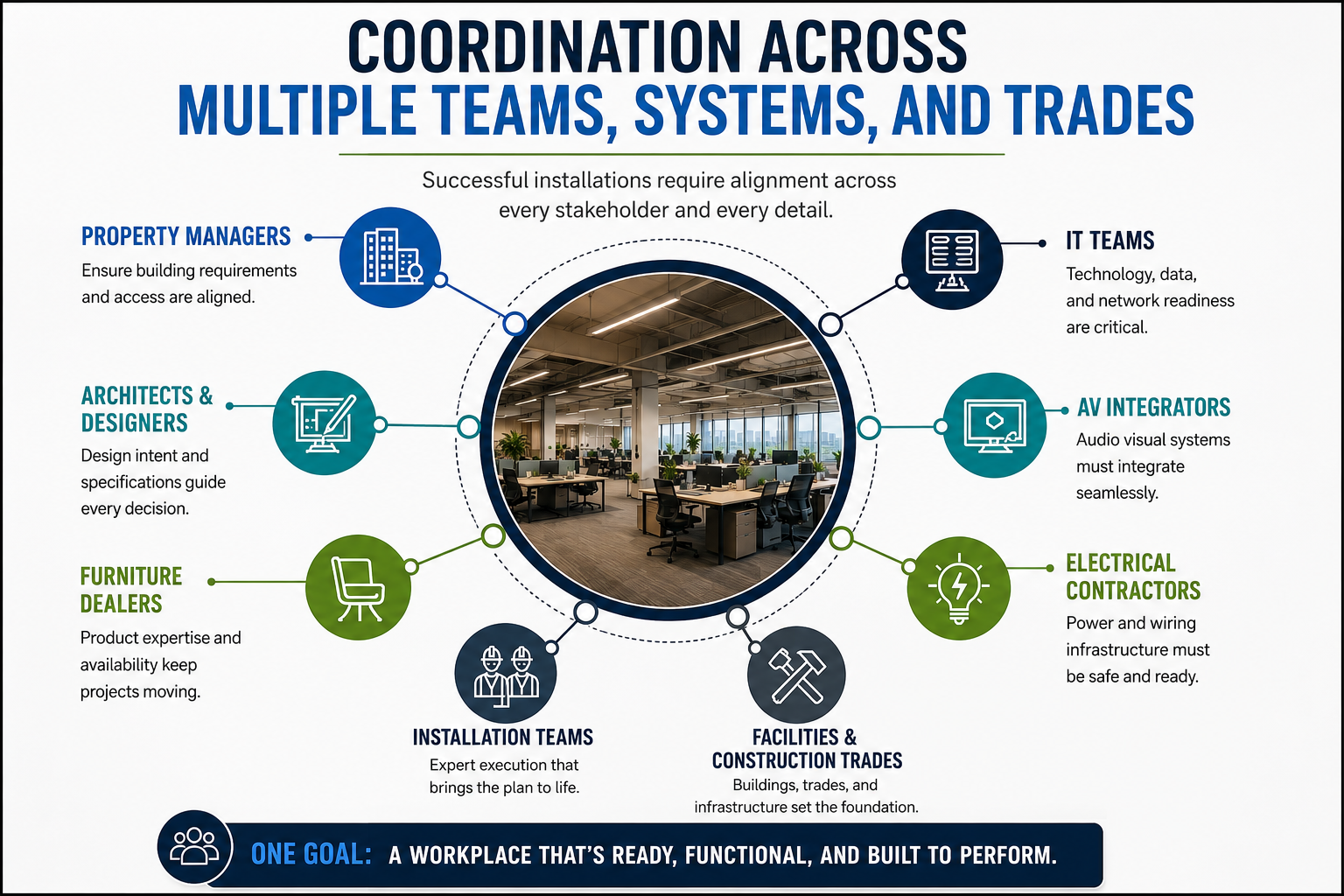 infrastructure. Even a standard workstation installation may require coordination between:
- IT teams
- AV integrators
- Electricians
- furniture installers
This growing overlap between technology and furniture systems is one reason organizations are rethinking how workplace projects are delivered.
Related Reading: Why Speed of Workplace Deployment Matters More Than Ever
Because in modern workplaces, delays or misalignment between systems can quickly impact deployment timelines.
Flexibility Requires More Precision
The rise of modular workplaces has introduced a new level of execution complexity.
Demountable walls, modular furniture systems, and reconfigurable layouts create tremendous flexibility, but only if they’re installed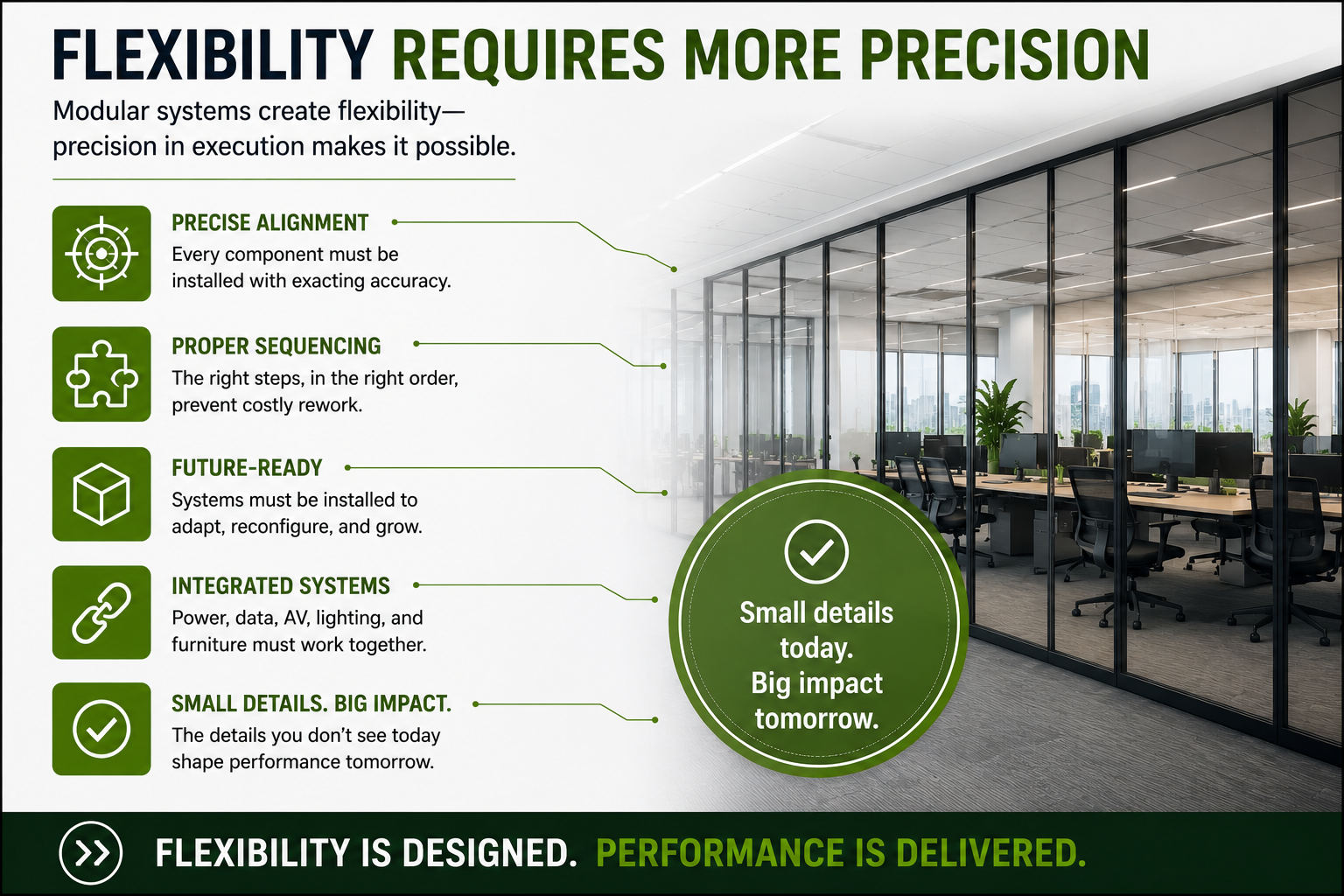 correctly from the start.
Unlike traditional fixed environments, modular systems must be:
- Precisely aligned
- Properly sequenced
- Future-ready for reconfiguration
- Integrated with surrounding systems
A small installation issue today can create major operational limitations tomorrow. This is where the Workplace Execution Gap often becomes visible.
Not because the design failed. But because execution didn’t fully support how the workplace was intended to evolve over time.
Related Reading: The Office Isn’t Dead — It’s Being Re-Engineered
Today’s Workplace Projects Require Cross-Functional Coordination
Modern office installations now require alignment across an increasingly wide network of stakeholders.
That includes:
- Property managers
- Architects and designers
- Furniture dealers
- IT teams
- AV integrators
- Electrical contractors
- Facilities teams
- Construction trades
- Furniture Installation teams
Each group operates on its own timelines, dependencies, and deliverables.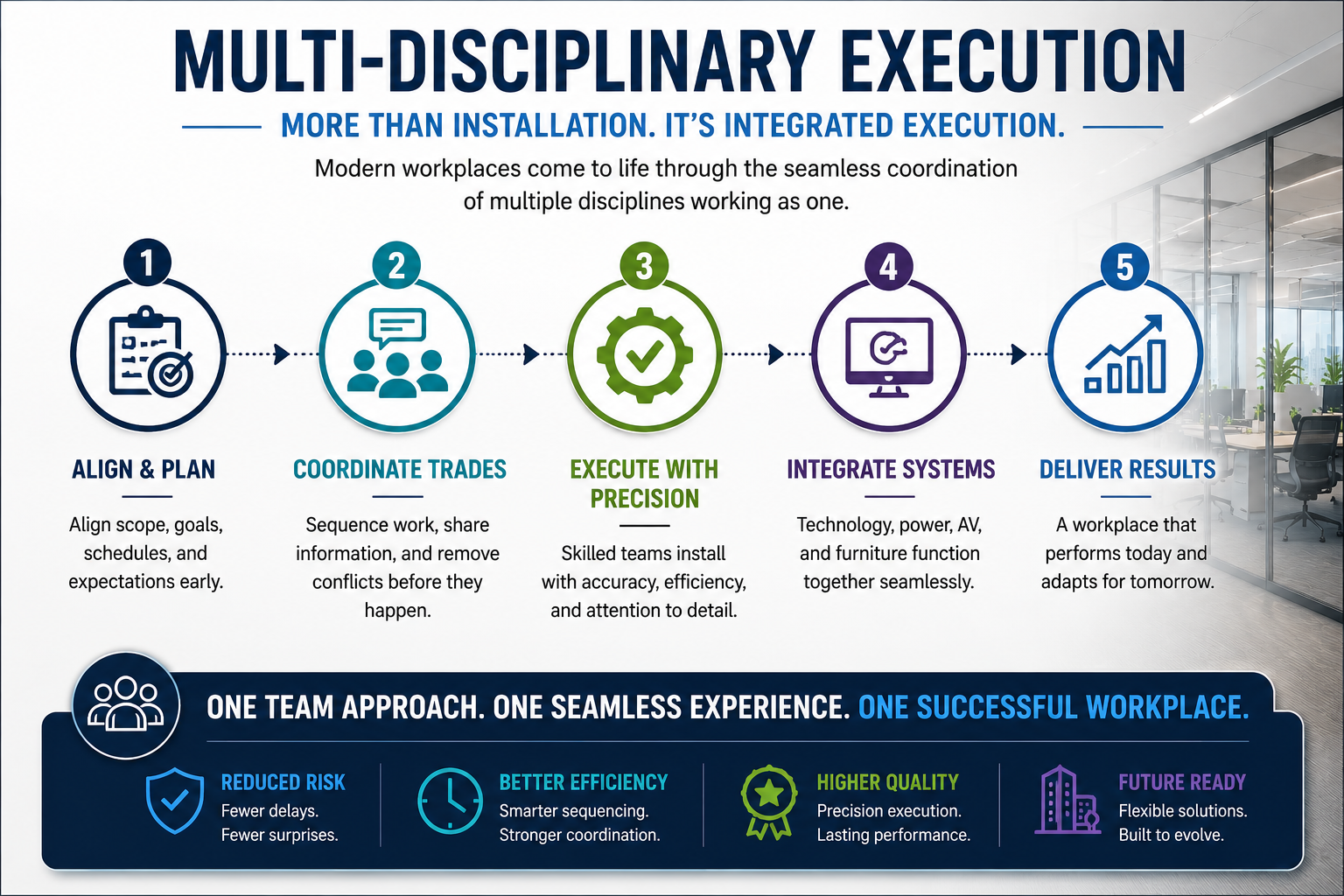
And when even one element falls out of sync, the entire project can feel the impact. That’s why successful workplace delivery today depends less on isolated execution and more on coordinated execution across every team involved.
According to an article by the International Facility Management Association (IFMA), workplace flexibility and integrated technology continue to be among the top priorities shaping future office environments.
The Rise of Multi-Disciplinary Execution
This evolution has fundamentally changed the role of workplace installation. Installers are no longer simply assembling furniture. They are coordinating within complex workplace ecosystems where multiple systems must work together seamlessly.
Modern workplace delivery now resembles a form of multi-disciplinary execution management which includes:
- Sequencing installations around other trades
- Coordinating technology readiness
- Supporting architectural integration
- Managing field adjustments in real time
- Ensuring future adaptability remains possible
The workplace may feel simple once completed. But behind the scenes, delivering that experience requires an extraordinary amount of coordination.
Why This Matters More Than Ever
As organizations continue prioritizing:
- Workplace flexibility
- Faster deployment timelines
- Hybrid collaboration
- Technology integration
- Employee experience
…the complexity behind workplace execution will only continue to grow.
And the organizations that succeed will be the ones that recognize a critical truth: Modern workplace projects are no longer just installation projects. They are coordinated operational deployments involving people, systems, technology, and environments working together in real time.
Frequently Asked Questions
Why are modern office installations more complex today?
Modern office installations now integrate technology, modular furniture systems, architectural walls, acoustics, and workplace flexibility. This requires coordination between multiple trades and teams, including IT, AV, electrical, facilities, and installation professionals.
What is a modular workplace?
A modular workplace is an office environment designed for adaptability and future reconfiguration. These workplaces often include demountable walls, modular furniture systems, flexible collaboration spaces, and integrated technology solutions.
Related Reading: The Rise of the Modular Workplace
Why do office installation projects require coordination with IT teams?
Today’s furniture systems often include integrated technology such as power routing, docking stations, conferencing tools, monitor systems, and smart workplace technology. Installers must coordinate closely with IT and AV teams to ensure all systems function properly together.
What causes delays in workplace deployment projects?
Many workplace deployment delays occur when project sequencing, technology readiness, product availability, or trade coordination fall out of alignment. Coordinated execution across all stakeholders is critical to maintaining timelines.
Related Reading: Why Speed of Workplace Deployment Matters More Than Ever
What is the Workplace Execution Gap?
The Workplace Execution Gap is the difference between workplace design vision and real-world delivery. It occurs when execution challenges prevent a workplace from functioning as originally intended.
Next in the Workplace Evolution Series
What Architects Wish Installation Teams Understood
How execution quality directly impacts design intent, user experience, and long-term workplace performance.